
What Is a Court Docket in Missaukee County
A docket, also called a register of actions in Michigan, is a chronological index of case events. It lists each filing, hearing, and order by date, in the order they happened. It does not hold the documents themselves. It tells you a motion was filed, not what the motion argued.
The full case file is the deeper layer. It holds the actual complaints, motions, exhibits, and signed orders. The docket is the map, and the file is the territory. For most people tracking a case, the docket answers the everyday questions. What happened, when, and what is scheduled next.
The broadest dockets belong to the Missaukee County circuit court, which handles felonies, larger civil claims, and divorce. The district court dockets run heavy with traffic and misdemeanor events. Probate dockets track estates and guardianships.
A docket is useful for a plain reason. It shows status at a glance. You can see whether a case is open or closed, whether the next hearing has a date, and how far a case has moved from its first filing. That makes the docket the natural first stop before anyone orders the full paper file.
How to Find Missaukee County Dockets Online
Missaukee County dockets are searched online through MiCOURT Case Search, the statewide public case lookup. Coverage depends on the court and case type. A docket that appears there shows the case number, the parties, the event history, and the next hearing where the court posts it.
Pick the court level before you search. Felony and divorce dockets live in the circuit court. Traffic and misdemeanor dockets live in the district court. Estate and guardianship dockets live in probate.
The circuit court's family division page lists the scheduling contacts for divorce, paternity, and juvenile matters.
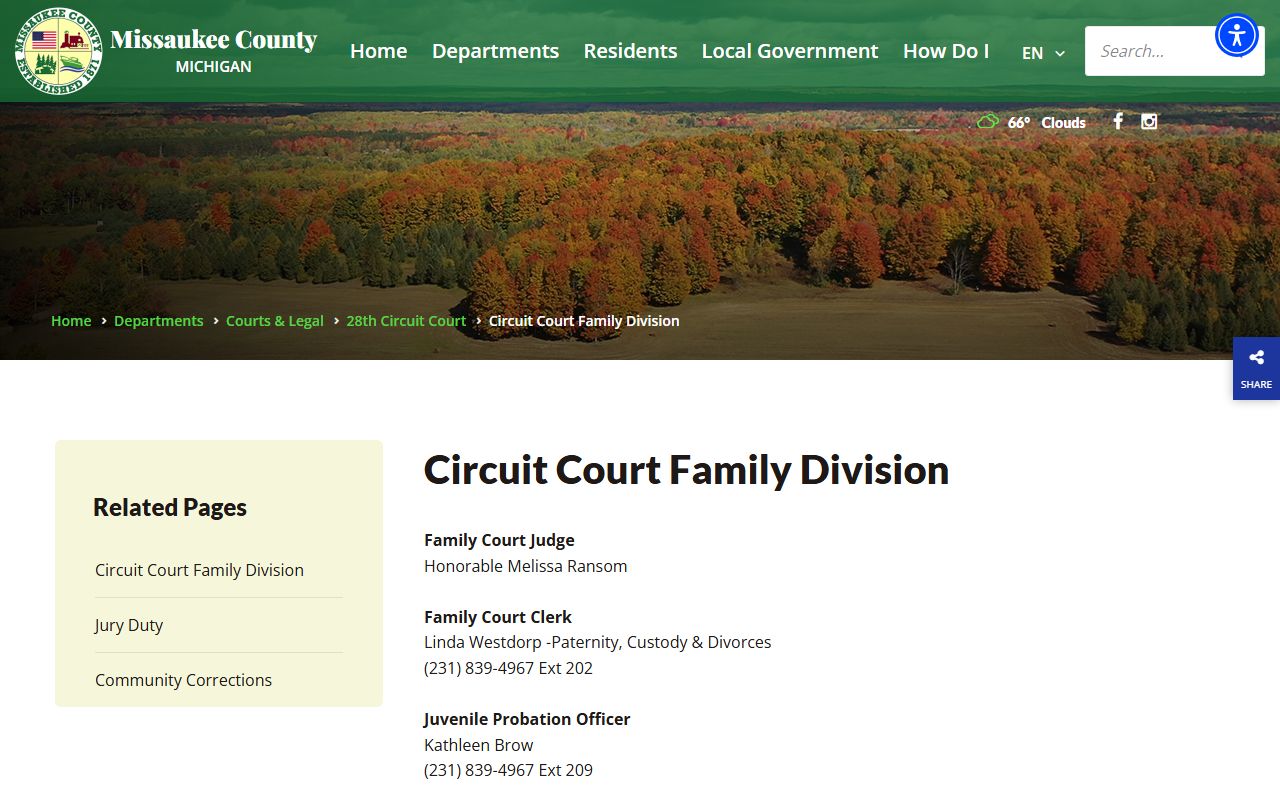
Those direct lines matter when a family docket is not fully posted online and you need the next date.
- Open the MiCOURT Case Search portal.
- Select Missaukee County or the specific court if the filter appears.
- Enter a case number, or search by last name and first name.
- Open the matching case to see its register of actions.
- Read the entries from top to bottom to follow the case timeline.
Sample Missaukee County Docket Entry
Each line on a Missaukee County docket follows the same shape. A date, an event, and often a short note or a link to the filed paper. Read across a single row and you learn what happened and who acted. Read down the column of dates and you get the full case timeline. The events below are the ones that appear most often across circuit, district, and probate files.
| Docket Event | What It Means |
|---|---|
| Complaint filed | Opens the case and states the claim or the charge. |
| Summons issued | Notifies a party to answer or to appear. |
| Arraignment | First criminal hearing on charges, rights, and bond. |
| Bond set | Records the money or the conditions for release. |
| Preliminary exam | District-court hearing that tests felony probable cause. |
| Motion filed | A written request asking the judge to act. |
| Hearing scheduled | Places a date on the court calendar. |
| Order entered | Records the judge's written directive. |
| Judgment entered | Records the final decision in a civil case. |
| Sentencing | Records the penalty after a conviction. |
| Warrant issued / recalled | Notes a warrant created or later withdrawn. |
| Case closed | Marks the case complete. |
Not every case shows every event. A traffic file may skip straight from citation to disposition, while a felony runs the full chain from complaint to sentencing.
Courts That Publish Dockets in Missaukee County
All three Missaukee County trial courts keep dockets, but they differ in what they post and how you reach them. The circuit and district courts are shared with a neighboring county, while probate is county-based at the courthouse. Online coverage runs through the same statewide case search for each level.
- Circuit court: felonies, civil claims over $25,000, family division, and personal protection dockets.
- District court: misdemeanors, traffic, small claims, and landlord-tenant dockets.
- Probate court: estate, guardianship, conservatorship, trust, and mental health dockets.
Probate adds a channel the others do not. Its staff will run a name search by phone or email at no charge for creditors in a decedent's estate or for genealogy researchers. Give the name and the approximate date of death. Mailed requests need a stamped return envelope, and copies of documents cost money.
When a case is not online, the counter is the backup. Circuit files go through the county clerk, who is also clerk of the circuit court. District files go through the district court office. Probate files go through the probate court office. All three share the county courthouse, so a single trip can cover more than one court level.
The circuit court also offers an aggregate view of its caseload. It links an Interactive Court Data Dashboard that reports case activity across the shared Wexford and Missaukee docket. The court states that, historically, it exceeds the statewide average processing times for its caseload. That summary sits beside the case-by-case register of actions. It gives a sense of how busy the local docket runs and how fast a filed matter tends to move.
Tracking Filings Through MiFILE
Michigan's e-filing system, MiFILE, is a second way to follow a case as it moves. Parties can see the documents filed, served, and noticed through their account for up to one year. That view works alongside the public docket rather than replacing it, and it is most useful to people who are part of the case.
In Missaukee County, probate accepts e-filing for set categories of cases. Eligible types include guardianships, conservatorships, decedent estates, and trusts. Attorneys are required to e-file under the court rules, while other filers may choose to e-file eligible cases. Account creation is free, and filing fees are paid by credit card in the system.
The sign-in page for the state system is the MiFILE login. It is a filing tool, not a public case-search engine, so a general docket lookup still runs through the statewide case search.
Docket vs. Full Case Record
The docket and the full case record answer different questions. One shows the sequence of events at a glance. The other holds the documents behind those events. Missaukee County researchers usually start with the docket and pull the full file only when they need the actual paperwork. The complete file and what it contains are covered on the Missaukee County court records page.
| Docket | Full Case Record | |
|---|---|---|
| Format | List of dated entries | Full documents and exhibits |
| Access | Often online and free | May require a fee or a visit |
| Use | Track case progress | Legal review and evidence |
| Source | MiCOURT register of actions | Clerk, district court, or probate |
Note: A docket confirms that a document exists and when it was filed, but you often still need the clerk to supply a certified copy of the document itself.
Hearing Dates and Jury Call-In
A docket entry that reads "hearing scheduled" sets a date, but dates can move. Missaukee County runs a call-in system for people tied to a trial date. Jurors selected for a term serve the circuit, district, and probate courts, and they confirm each date by phone the evening before. That call-in step keeps a docketed trial date current.
The county's jury duty page explains the questionnaire, the two-month term, and the call-in step.
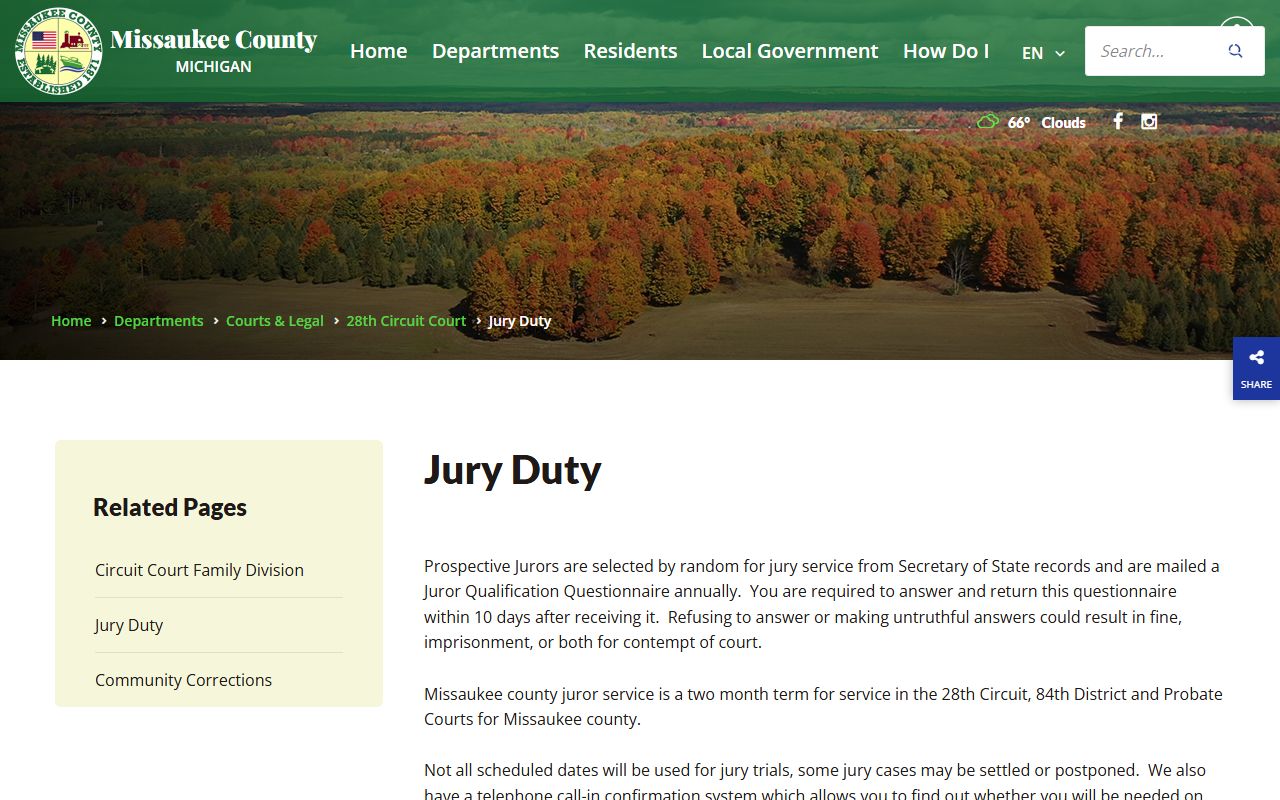
Jurors call after 5:30 PM the day before a trial to learn whether to report, and the court warns that high call volume can cause busy signals.
Current panel notices and excusal steps sit on the jury duty information page.
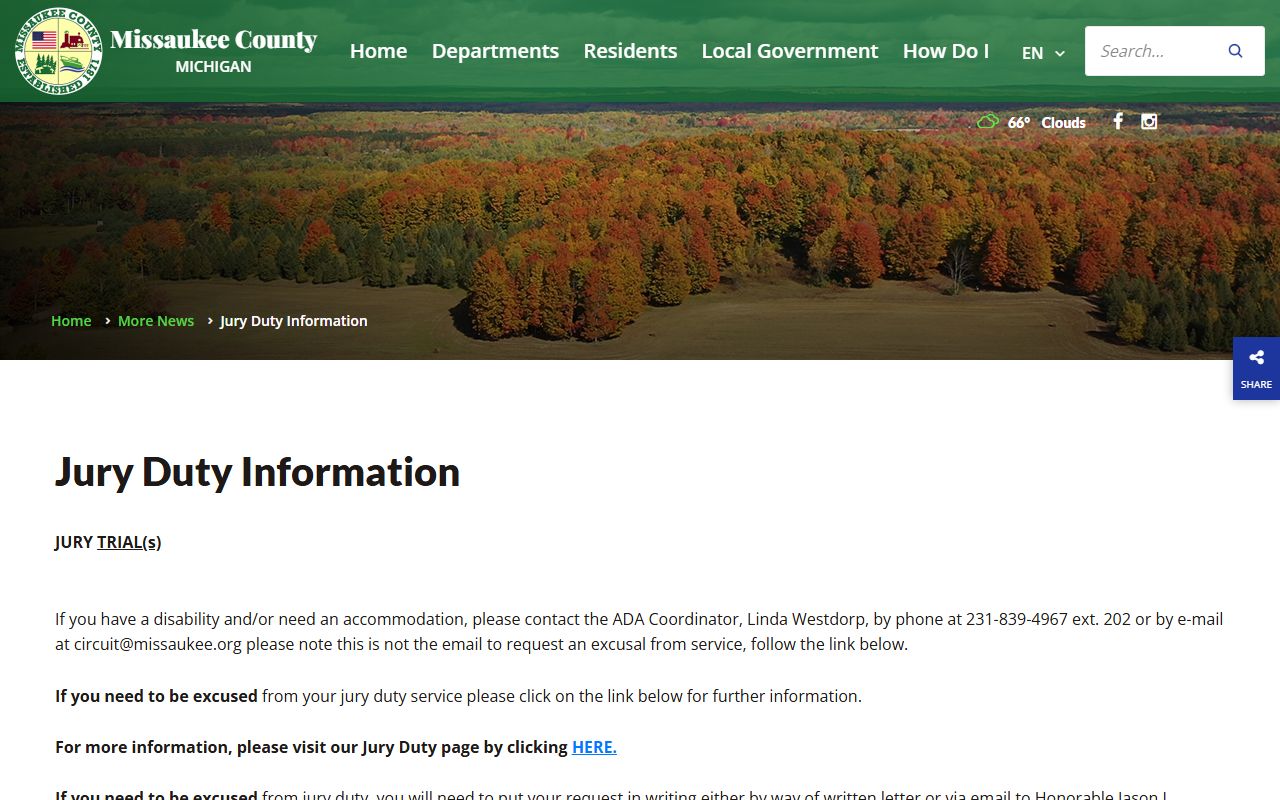
Written excusal requests must reach the court before 1:00 PM the day before trial, so a docketed date and a call-in check work together.
How to Read a Missaukee County Docket
Docket lines use short terms and codes. A few appear again and again across Missaukee County cases, and learning them removes most of the guesswork. The definitions below cover the words you will meet most.
- Register of actions
- The Michigan name for the full docket, listing every filing and event.
- Disposition
- The outcome of a charge or case, such as dismissed, guilty, or judgment entered.
- Bindover
- Transfer of a felony from the district court to the circuit court.
- Continuance
- A court-approved delay that pushes an event to a later date.
- Motion and order
- A party's request and the judge's written answer to it.
- Bond
- The money or conditions set for release before a case ends.
The disposition lines are the ones to watch, because they tell you how a charge or claim ended. If a docket looks incomplete or shows no document images, the local clerk can supply certified copies and confirm the current status.
Read a docket in order and a pattern appears. Early lines open the case and set the schedule. Middle lines carry motions, hearings, and orders. Late lines carry the judgment or the sentence, then the close. A gap of several months between lines usually means a continuance or a pending hearing rather than a lost record. When the timeline stops making sense, a call to the court that holds the file clears it up faster than a second online search.